Cash-Out Refinance Calculator — borrowing against a house you own
Every field, the formula behind it, and a worked example.
Last updated:
Help › The calculators › Taking cash out of the house
Borrowing more against a house you already own: what the new loan becomes, what share of the value that is, and the new instalment.
 Open this calculator
01
When to use it
When you need a lump sum — building, a business, a family need — and the house is the largest thing you own.
02
Every field, explained
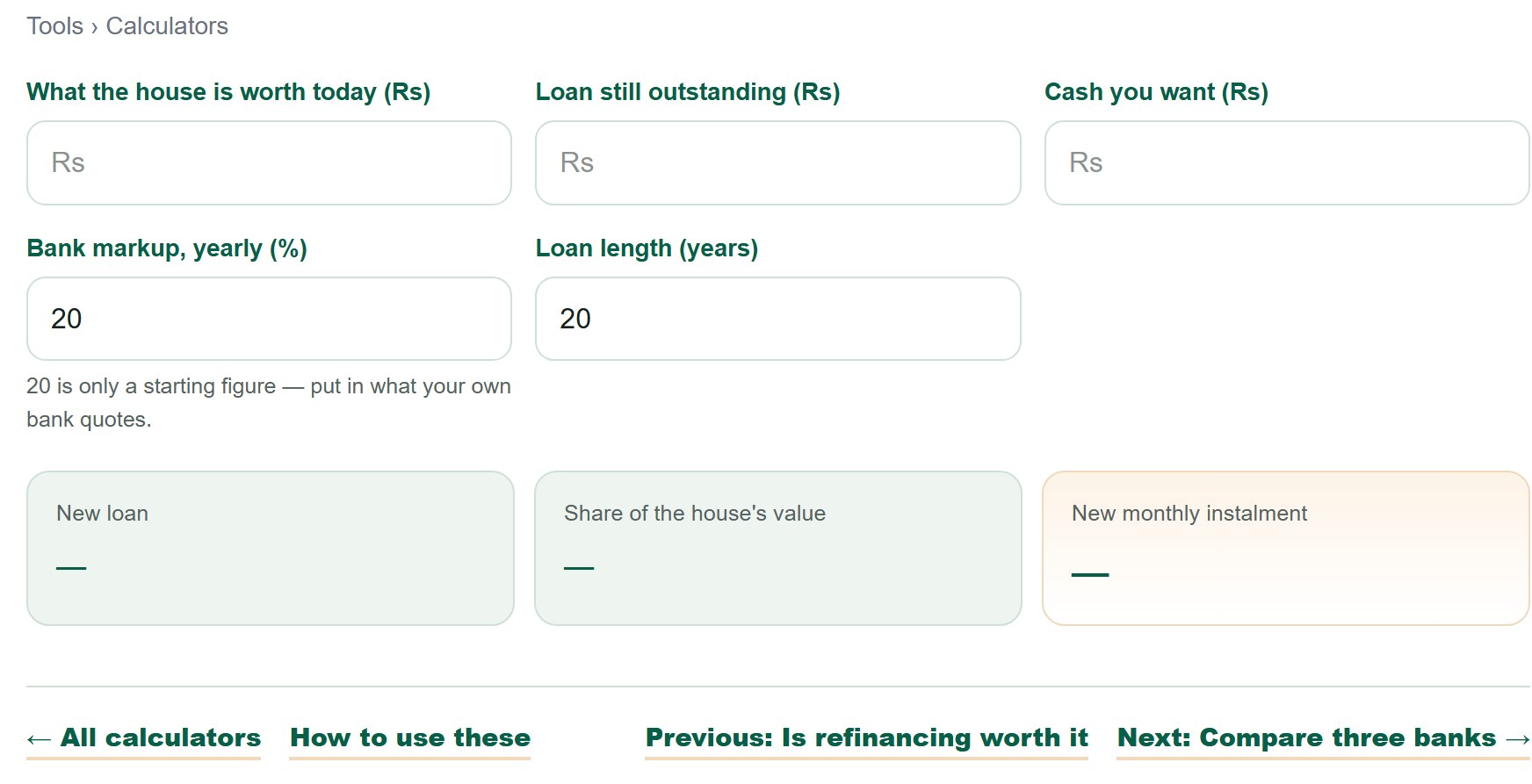
| What the house is worth today (Rs) | Today's honest value. The market report and the plot pages are the place to check, not a hopeful guess. |
| Loan still outstanding (Rs) | What you still owe on it. |
| Cash you want (Rs) | The lump sum you are trying to raise. |
| Bank markup, yearly (%) | The rate on the new, larger loan. |
| Loan length (years) | The new term. |
03
How the answer is worked out
- The new loan is what you still owe plus the cash you want.
- That is divided by the house's value to give the share you would owe against it.
- The instalment is worked out on the new total. Above 80% the share turns red, because that is roughly where banks stop and where a fall in prices would leave you owing more than the house is worth.
A worked example
| House worth | Rs 5 crore |
| Still owe | Rs 1.5 crore |
| Cash wanted | Rs 1 crore |
| New loan | Rs 2.5 crore (50% of value) |
At 20% over 15 years the instalment becomes about Rs 4.4 lakh a month. The cash is real, but so is the instalment — for fifteen years.
04
Mistakes people make
- Using a hopeful value for the house so the percentage looks safer.
- Taking cash out for something that does not earn — the markup runs for years afterwards.
- Forgetting that the new loan usually restarts the clock, so the early years are mostly markup again.
05
What it does not do
- It does not know whether your bank offers this at all — not every Pakistani bank does.
- It ignores processing fees and re-valuation charges.
- It cannot tell you whether the thing you want the cash for is worth it. That is the real question.
06
Questions
- Why does it warn above 80%?
- Is this the same as a second loan?
Because banks rarely lend past it, and because if prices fall you would owe more than the house is worth — the most dangerous position a borrower can be in.
Not quite. This replaces the existing loan with a bigger one. A second loan sits on top and usually costs more.