Home Equity Calculator — what share of the house you own
Every field, the formula behind it, and a worked example.
Last updated:
Help › The calculators › How much of the house is yours
Today's value minus what you still owe. That difference is the part of the house that is genuinely yours.
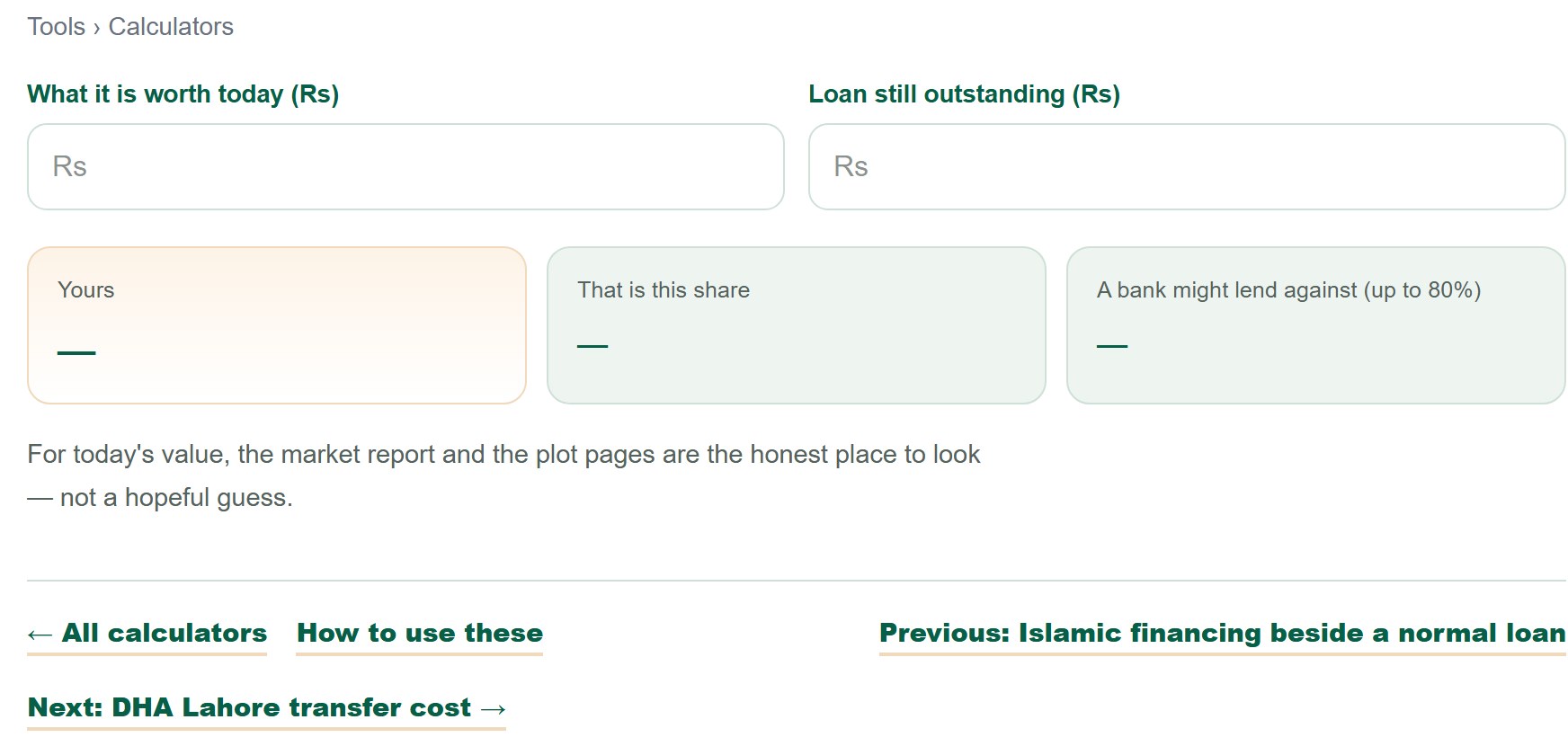 Open this calculator
01
When to use it
Once a year, to see where you stand. Also before asking a bank for anything — equity is the first thing they look at.
02
Every field, explained
| What it is worth today (Rs) | An honest figure. The market report and the plot pages give you a real one; the number a neighbour mentioned does not. |
| Loan still outstanding (Rs) | The balance on your statement, not the original loan. |
03
How the answer is worked out
- Value minus outstanding loan is your equity. If it comes out negative it turns red — you owe more than the house is worth.
- That equity divided by the value gives your share as a percentage.
- The third figure shows what a bank might lend against it: 80% of the value, minus what you already owe. That is roughly where lenders in Pakistan stop.
A worked example
| Worth today | Rs 4 crore |
| Still owe | Rs 1.2 crore |
| Yours | Rs 2.8 crore (70%) |
A bank lending to 80% of value would consider up to about Rs 2 crore against it — though whether you should borrow it is a different question entirely.
04
Mistakes people make
- Using a hopeful value. Equity built on a guess is a guess.
- Using the original loan instead of the balance left.
- Treating equity as spendable money. It is only real when you sell or borrow against it — and borrowing against it brings back an instalment.
05
What it does not do
- It is not a valuation. For a real figure, the market report, the plot page and a dealer who knows that block are the honest sources.
- It does not include what selling would cost you — commission, tax and DHA dues come off the top.
- The 80% line is a rule of thumb; your bank's limit may be lower.
06
Questions
- Why does equity grow so slowly at first?
- What raises equity?
Because in the early years almost all of your instalment is markup. The amortisation calculator shows this year by year — it is worth looking at once.
Two things: the price going up, and the loan coming down. Paying extra does the second faster, and it is the only one of the two you control.